Learning to care for school journeys: The CARE+ approach
How can children’s everyday experiences inform more sustainable mobility?
Learning to care for school journeys: The CARE+ approach
How can children’s everyday experiences inform more sustainable mobility?
In the initial CARE+ workshops, activities such as mapping, photography, play, creative design and the use of air-quality sensors are opening up different ways to explore this question. These activities also invite reflection on what it means to organise participation with care.
A school journey can look straightforward on a map. For a child travelling along it, the same route often involves uncertainty: Can I see the approaching car? Has the driver seen me? Where should I cycle when the road becomes narrow?
At Skårup School in Svendborg Municipality, 5th grade students brought questions like these into the CARE+ project in which a series of workshops have been organised during August to October 2026. Pupils told their stories of everyday home-school travel through mapping their surroundings, photographing places where they felt unsafe, carrying air-quality sensors to measure CO2, identifying the problems and developing their own ideas for change. The workshops offer a concrete example of the methodological questions CARE+ explores: how do we bring different forms of knowledge together, how do we support children’s contribution to sustainable solutions, and how to connect climate action with attention to everyday needs and relationships.
Beginning with children’s knowledge
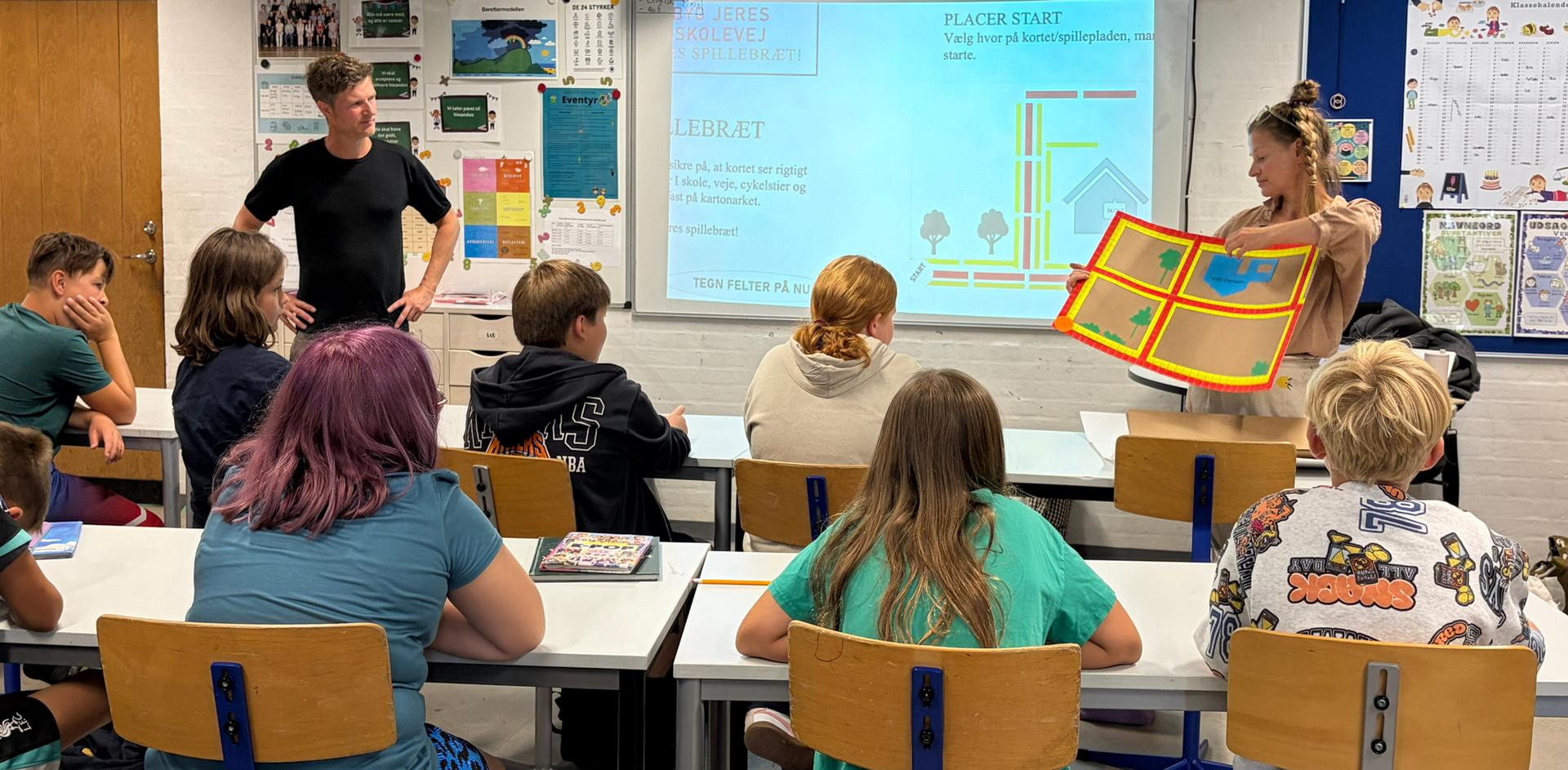
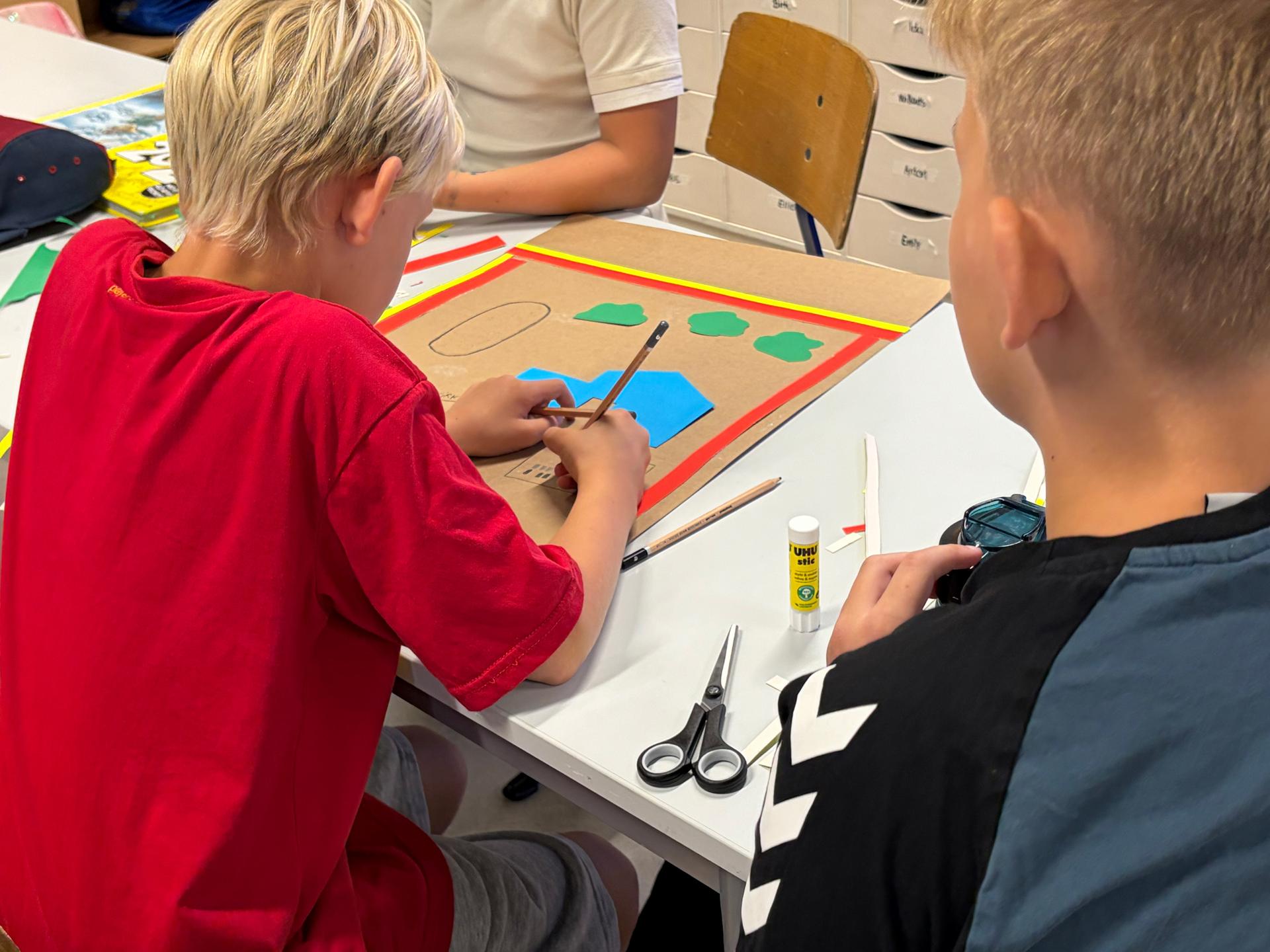
In the first workshop, we invited pupils to construct maps of the school roads (school catchment) using analogue craft materials and digital reference maps. The pupils worked in groups of 3-4. This gave them the opportunity to engage in a close dialogue about their experiences with everyday transport, sharing their individual stories, and allowing voices of all the children to be heard. It also showed how each group approached the mapping tasks differently. Some began with focusing on the roads, others located the school first, while others started by making trees and greenery.
These differences prompted questions for the CARE+ research team. What helps children represent a familiar place? Which features matter to them? How do the materials and instructions influence what appears on a map? What are the most notable elements they encounter on their journey from home to school? And how can we embrace children’s differences?
The process also revealed difficulties. One group asked to go outside to understand the street layout more clearly; others checked the surroundings through the window or used digital maps. Some pupils needed more time and support. Also, the children’s perspectives were shaped by the different ways they usually get to school: by bike, on foot, by bus, or by car.
From a care perspective, these moments deserve attention. Participation requires sensitivity to how different children might understand a task and what enables them to contribute. A completed map is one source of knowledge; the conversations, questions and adjustments involved in making it are another. This experience left us reflecting on how they recall their journeys between home and school and what kinds of support they need to map these journeys.
Taking the investigation outside
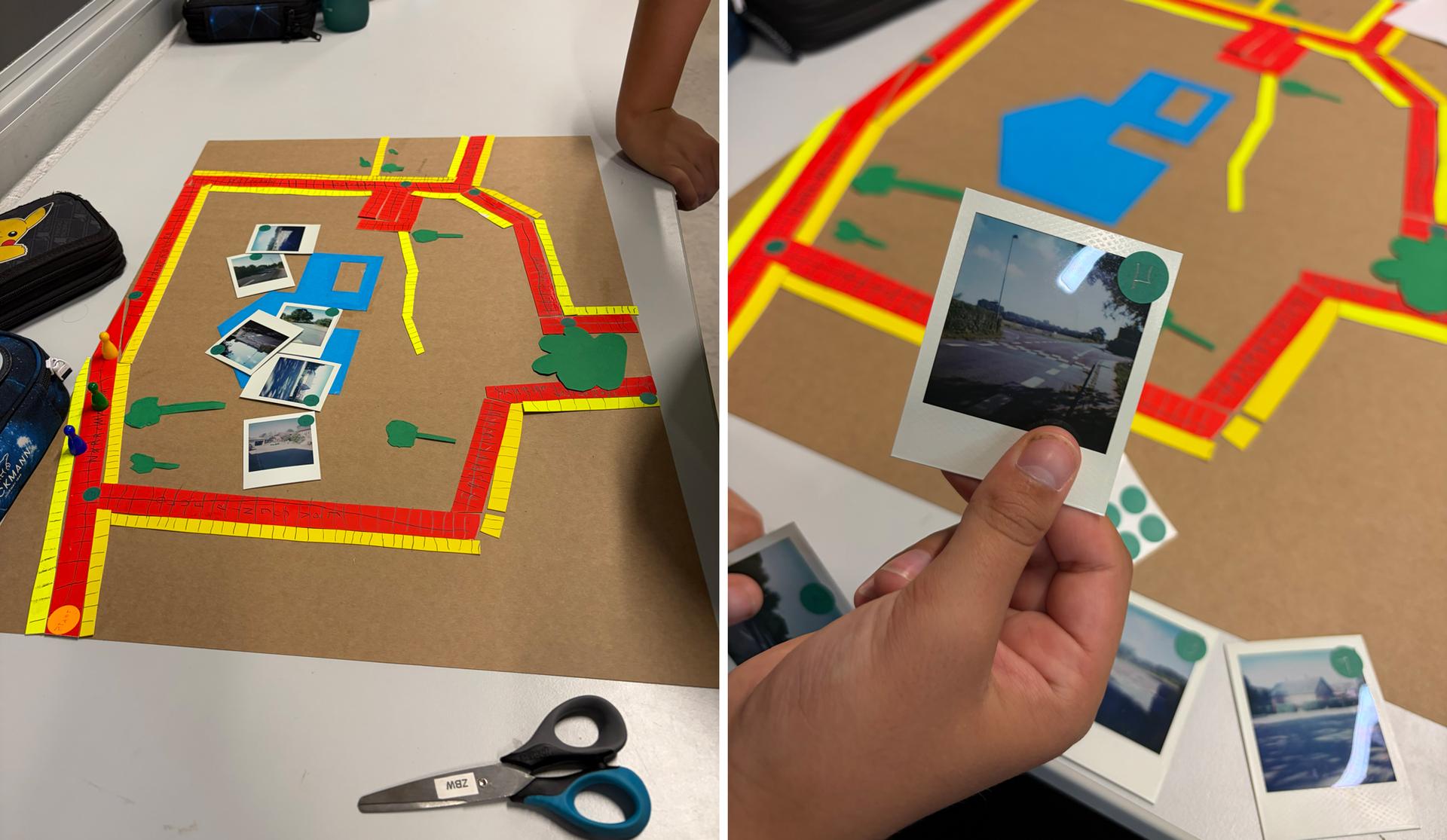
In the second workshop, we let pupils explore the area with analogue cameras, asking them to photograph four places where they felt unsafe. Back in the classroom, they selected photographs, located them on their maps and developed accompanying stories in few words for each photograph.
Their accounts particularly highlighted difficulties seeing approaching vehicles, uncertainty at junctions and conflicts around parking areas and the bus stop. Pupils also identified possible alternative drop-off points from which children could walk the final part of the journey.
These were children’s reported experiences, offering situated knowledge of how the school environment feels and functions for its young users. Photography provided a way to connect discussions with particular places. Maps, photographs and stories allowed experiences to be expressed in several forms, giving the CARE+ team different opportunities to listen and ask questions.
Read also here: Photovoice – seeing the school route through children's eyes
Using play to revisit familiar routes
The pupils’ maps became board games. As some groups played, students noticed that routes were missing from their maps and returned to revise their representations. Playing the game prompted them to reconsider how places are connected and whether their maps accurately reflected the journeys they knew from everyday life.
The CARE+ team’s ambition was to make play an integral part of their investigation. By constructing and moving through the game, testing routes and discussing the connections between places, we observed how the pupils revisited and developed their mapping. Gaming should make them explore their everyday experiences from a new and fun perspective and provide ownership and engagement.
During the process, we learned that for some children, constructing the board game was too time-consuming. While we continuously simplify the process, we are also testing new formats that still incorporate games, for instance, by developing question cards based on photographs, CO2 measurements, storytelling, and peer surveys.
Our approach and observations during the workshops illustrate an important aspect of the CARE+ methodology: understanding can develop through making, using and revising something together. This applies both to the children and to us as a team. Creative activities do not simply translate existing knowledge into a final product; they can also generate new observations, questions and insights along the way. In this way, the process creates opportunities for children and adults to discover perspectives and challenges that were not visible at the outset.
Read also here: Learning about mobility through board games (coming soon)
From concerns to possible changes
The third workshop shifted towards developing responses to previously identified problems. Two representatives from Svendborg Municipality joined part of this session.
Pupils worked through drawings, models and discussions. After categoriezing and introducing the problems students in the groups have been identified in the last workshop, they began to choose the problem they wanted to work with among them and developed some ideas to solve those selected problem. Their emerging ideas included more space for cycling, changes to crossings, parking restrictions and time-limited restrictions on car access near the school. These were preliminary directions for exploration rather than agreed designs. They made their solutions through making them with playdough in either 2D or 3D versions.
For CARE+, this stage raises a question of responsibility: what happens after children have contributed their knowledge and ideas? How can these be put into practice in ways that ensure children genuinely feel heard and see that they make a difference?
A care-oriented process involves following those contributions beyond the workshop. It requires exploring what can be taken forward, what needs further investigation, and which decisions depend on other actors. It also gives the children an insight into a system where solutions in the transport sector are often expensive. Making these connections visible is an important task for the continuing collaboration.
Another aspect that emerged for reflection was how students develop a sense of belonging and ownership in relation to the project and their contributions. To encourage this, at the end of the workshop, students playfully created mascot figures that they wanted to use as a form of visual identity for their series of workshops, this time at the school level.
Interestingly, the students drew inspiration from videos of previous workshops conducted in other schools. This raised a further question about the role of external sources of inspiration in creative activities: How much should students be exposed to existing examples, and how can we ensure that such exposure supports rather than limits their creativity?
Having a say in shared decisions
In the fourth workshop, pupils painted mascot figures and proposed names and slogans. To select the final mascot, name, and slogan, they participated in a voting process. This gave pupils a direct and visible role in shaping the project's shared outcomes. For the first time, the results were accepted without disagreements, even by pupils whose preferred options were not selected. In contrast, some pupils questioned a separate decision made by a facilitator without a similar voting process. This contrast raised an important point for reflection about how participation in decision-making processes may influence pupils' sense of ownership, fairness, and acceptance of collective outcomes.
These observations invite reflection on how influence is experienced. Being offered an engaging activity and having a recognisable say in its outcome are distinct aspects of democratic participation. Both deserve attention when adults design activities with children.
Care ethics helps us ask whose preferences are heard, how decisions are explained and how facilitators respond when participants disagree.
Bringing sensors into everyday life
The fourth workshop also introduced air-quality sensors. Pupils received information and demonstrations about air quality and sensors’ measurements, asked practical questions, and were organised into sharing groups according to how they travelled to school. A measurement period was planned for 11–21 September, with a schedule arranged for students in each group to share a sensor.
This extended the investigation beyond the workshop room. It created an opportunity to connect environmental measurements with the journeys pupils had already mapped and discussed.
The workshop reports have not yet established what the measurements show. The methodological opportunity lies in bringing these sources into dialogue: what instruments measure what, what children notice and how they interpret the places they move through.
Care as a practice of attention and response
Across the workshops, participation required adjustments. Different activities supported different pupils; some tasks needed more time, clearer explanations or additional facilitation. Hands-on work, outdoor exploration and opportunities to make choices often appeared to support engagement.
Through the lens of care ethics, these experiences highlight four connected responsibilities: attending to children’s concerns; taking responsibility for responding; providing appropriate support; and remaining open to feedback about whether that support works.
This also means recognising participation as a demand on children’s time and energy. They need to understand why an activity matters and how their work connects to the wider process.
At Skårup School, the workshop series provides a setting in which CARE+ can examine these responsibilities in practice. The value lies here both in the knowledge and ideas produced with children and in what the CARE+ team can learn about organising meaningful participation for all children.
Connecting care with climate action
Walking and cycling to school depend on the various conditions surrounding everyday journeys: street layouts, visibility, traffic movements, family arrangements, and opportunities to travel with others or by yourself.
CARE+ approaches climate action through these relationships. Children’s experiences can help identify where change is needed, while collaboration among schools, local organisations, researchers, and municipalities can explore possible responses, methods and new perspectives.
The Skårup workshops provide early material for this inquiry. As the CARE+ team is still early in the process, demonstrated changes in travel behaviour, emissions, or road safety take time. Yet, our work shows how children can investigate their surroundings and contribute to discussions about their future – and how adults can learn to support that contribution with care.
Children voices at the spotlight
The four workshops concluded with a rehearsal and a final event, during which pupils shared their findings, ideas, and efforts with younger students at the school. The rehearsal provided an opportunity for pupils to prepare for the event by practising their presentations, organising cycling activities to teach other students, and participating in video recordings that would later be shown during the event.
On the event day, the pupils who had participated in the workshops gathered in the school's meeting room, together with students from grades 0 to 5. They presented their experiences, the challenges they had identified, and the solutions they had developed throughout the workshops. These included proposals for improving parking areas, introducing speed limits, and closing certain roads during school hours to create safer routes to school. They also answered questions from other pupils and shared their recorded videos, accompanied by playful music, creative outcomes, and the mascot figures they had designed.
Following the presentations, the pupils took on different roles in organising activities for other classes. Some guided younger students from grades 0 to 2 on a tour around the school, stopping at several locations where their colourful mascots had been placed. At each stop, they explained what the mascots represented and shared their ideas for improving mobility and safety in those areas. Other pupils were responsible for organising cycling activities, where they introduced older students to cycling rules through practical exercises and playful challenges. At the end of these activities, participants received a "cycling certificate" to acknowledge their participation.
Throughout the event, the pupils seemed enthusiastic, engaged, and proud of their contributions. They wore stickers featuring their mascots and slogans on their clothes, making their shared identity and achievements visible to others. It was rewarding to observe how confidently they communicated their ideas, not only with other pupils but also with adults, including researchers, facilitators, and municipal representatives. The willingness to explain their proposals and answer questions suggested a growing sense of ownership and responsibility over both the process and its outcomes.
Read also here: From Children’s Ideas to Traffic Improvements at Skårup School (coming soon)
Looking back at the journey across the four workshops and the final event, one of the most meaningful observations was how pupils gradually became more involved in the activities, more confident in expressing their ideas, and more attentive to the experiences and needs of others. What began as an exploration of their everyday routes to school developed into an opportunity for them to communicate their concerns, propose changes, and share their knowledge with the wider school community. This experience also invites reflection on how a care ethics approach involving children requires participatory processes to create opportunities for children not only to contribute ideas but also to experience how their voices are heard and their contributions are valued.
CARE+
CARE+ is supported by the Novo Nordisk Foundation and coordinated by Aalborg University, in partnership with the University of Copenhagen, DiverCities, Miljøpunkt Amager, Trafik i Børnehøjde and EIT Urban Mobility.