From everyday journeys to shared responsibility: CARE+ at Glamsbjergskolen
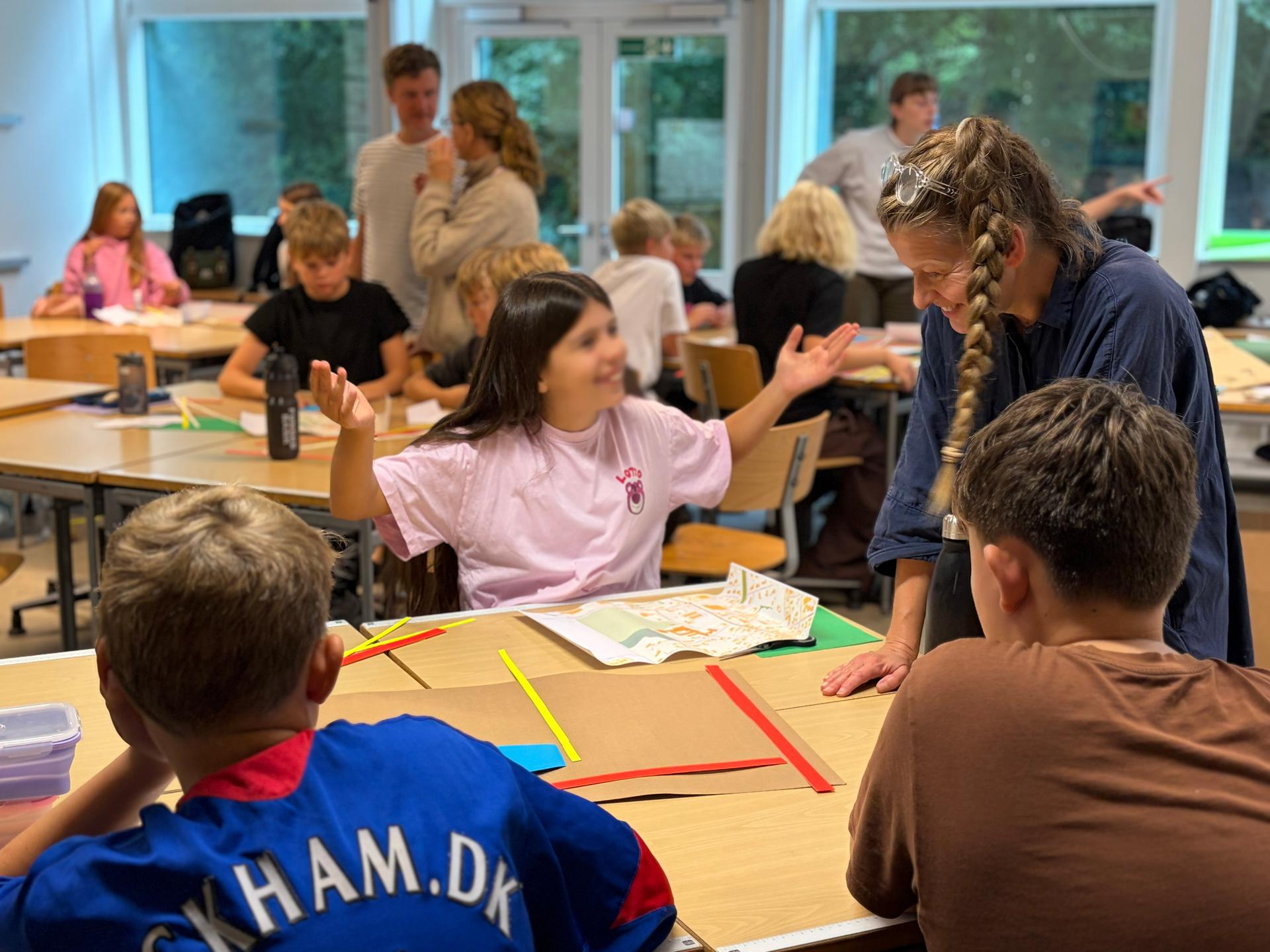
What happens when children investigate their journeys to school—and use what they discover to help younger pupils navigate the same surroundings?
From everyday journeys to shared responsibility: CARE+ at Glamsbjergskolen
What happens when children investigate their journeys to school—and use what they discover to help younger pupils navigate the same surroundings?
At Glamsbjergskolen , located in Glamsbjerg, a town in Assens Municipality on the Danish island of Funen, the CARE+ project combined photography, mapping, board games, creative design and cycling activities to explore everyday mobility from children’s perspectives. Through four workshops in 1 to 30 September, pupils from Class 5A documented places they found difficult to navigate, developed ideas for improvement, and guided younger children through walking and cycling activities. These activities were followed by a school event on 3 November 2026, which the children had rehearsed the day before.
The process offers a practical example of CARE+’s approach to connecting climate-conscious mobility with an ethics of care. It begins with listening to children’s experiences, creates different ways for them to contribute, and opens opportunities to put care into practice by attending to others’ needs. Children’s knowledge of their everyday surroundings becomes a starting point for shared learning about safer and more sustainable ways to travel.
Seeing the school surroundings through children’s eyes
The first workshop began with familiar questions: How did you travel to school today? Which route do you take? Where does the journey become difficult?
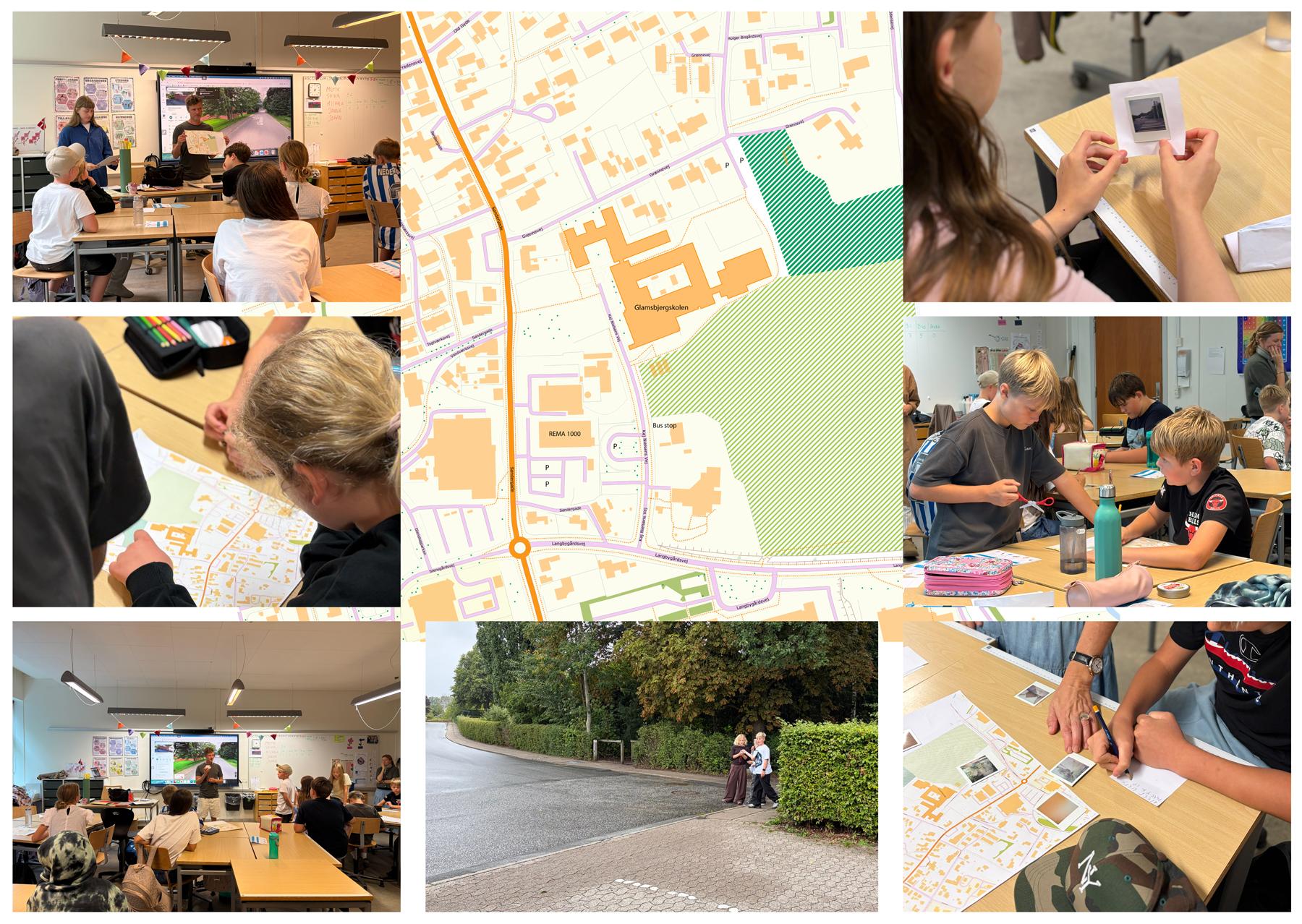
Working with printed maps, pupils discussed their everyday routes before taking Polaroid cameras into the surrounding area. Rain delayed their outdoor exploration, but once it stopped, they photographed places they wanted to discuss and wrote short stories explaining their observations.
Parking areas, intersections and encounters between cars, bicycles and pedestrians emerged repeatedly. The parking area around the Rema 1000 supermarket was a recurring reference point, with pupils describing difficulties moving through spaces shared by different road users. Children also looked beyond their own journeys: at one intersection, while taking photos, they discussed how difficult crossing could be for younger children.
Connecting photographs with children’s own accounts is central to this method, known as Photovoice. Together, images and stories help explain what makes a place feel difficult to navigate or unsafe and how experiences may differ between those using it. The pupils’ attention to younger children also brings the notion of care into the discussion: whose needs are being considered, and what would make these surroundings easier and safer for them?
Making and testing mobility games
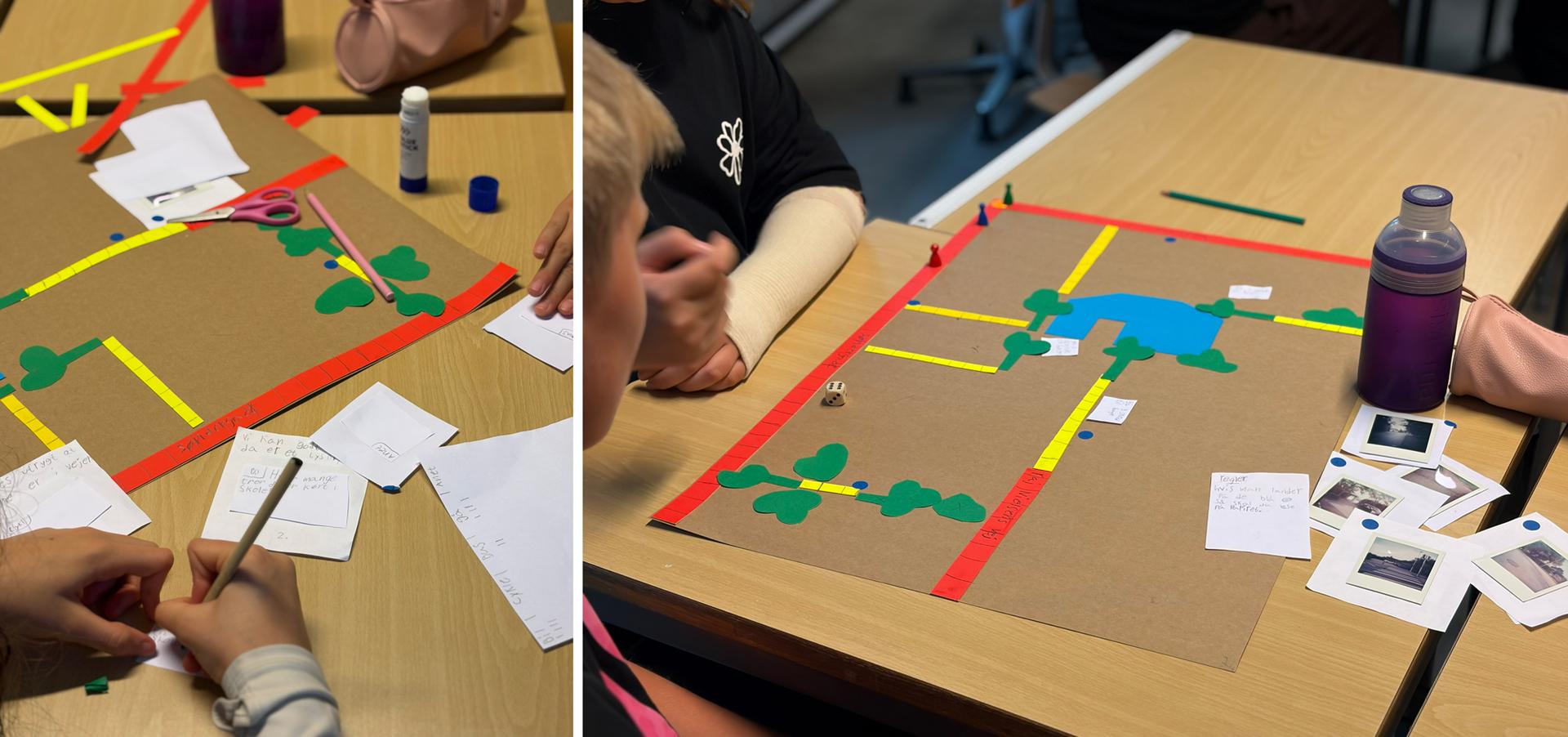
In the second workshop, pupils used their maps and photographs to create board games representing the school surroundings. Groups constructed roads and paths, added landmarks and street names, and marked the locations they had photographed. Some returned outside to take additional photographs, building on their earlier observations as their games developed. They also experimented with developing their own game rules and question prompt cards, incorporating playful activities and challenges, such as moving backwards during the game, to make it more engaging and enjoyable.
Playing brought another dimension to the task. When pupils exchanged games, they discovered that features familiar to the makers were not always clear to others. On one board, for example, the route did not clearly lead to the school—the intended destination. Playing together prompted pupils to explain their choices, identify missing elements and reconsider how their surroundings were represented.
The games created opportunities to explore how someone else might understand and navigate the same places. For facilitators, they also revealed which features children chose to emphasise, from intersections and paths to parking areas and familiar landmarks. Making and playing became complementary ways of sharing and discussing children’s knowledge of their everyday journeys.
Becoming investigators and developing ideas
The third workshop returned to the mobility problems through the pupils’ own photographs. Groups explored possible responses, including physical changes, communication and educational activities. They also developed characters that could help give their ideas a recognisable identity.
Moving from identifying a problem to proposing a solution was sometimes difficult. The CARE+ partners as well as the teacher helped pupils explain what they wanted to change, who would benefit, and how their ideas might work. Children also questioned the information presented to them: noticing that bus travel was missing from the mobility statistics, they asked for clarification about a mode of transport familiar to several classmates.
Pupils then became investigators themselves. Working in groups, they visited other classes to ask how children had travelled to school that day. They returned with their findings, which were brought together for discussion. The number of pupils arriving by car prompted questions about why families travelled this way.
The activity connected the workshop to the wider school community and gave pupils an active role in producing knowledge about everyday mobility. Collecting and discussing information from their peers offered a starting point for exploring travel choices and the conditions shaping them. The findings represented a snapshot of that day’s journeys, rather than evidence of changes in travel behaviour.
Different ways to contribute
The fourth workshop combined painting, naming and cycling. Pupils painted mascot figures and traffic-sign elements they had designed during the third workshop, suggested names and voted on their favourites. One character became Ole, accompanied by an invitation: “Hi, my name is Ole; come cycle to school with me.”
The varied activities opened different opportunities for participation. Some pupils who had struggled with board-game construction became absorbed in painting. Others who had contributed less to earlier sessions became more active and asked for additional tasks. Changing the activity allowed different interests and abilities to become visible, it also provides various opportunities for all students to contribute actively and engage in the process..
These observations bring a practical dimension to CARE+’s ethics of care. Meaningful participation requires attention to how each child can contribute – through speaking, drawing, making, moving or helping others. We also considered how to distribute visible roles and recognition across the class, including opportunities for children whose contributions might otherwise receive less attention.
Outside, pupils tested a cycling layout with a central roundabout and connecting lanes. Riding through it made movement patterns and difficulties tangible. Afterwards, they discussed what had worked and where the layout was difficult to navigate, helping inform preparations for teaching younger pupils.
During the energetic cycling activity, children were also observed showing concern for one another, checking whether their peers were okay, particularly when one child fell to the ground. Alongside designing and discussing a caring mobility infrastructure, they were practising care through attention to one another while moving through a shared space.
From workshop participants to peer guides
At the school event on 3 November, pupils shared their work with other classes, representatives from Assens Municipality, the mayor, police officers and a reporter. The event brought their investigations and creative work into a wider public setting.
Their role extended beyond presenting. Pupils guided younger children along a walking route with three stopping points around the school, including parking areas and bus-stop locations. Student-designed signs and mascots became conversation starters: younger pupils noticed them, asked what they meant and remembered the characters’ names. The children’s designs had become part of a shared exploration of the school surroundings.
At the cycling square, project pupils helped position signs, explain traffic rules and guide activities for younger classes. The space became a small traffic environment where children could practise moving together, with older pupils taking responsibility for helping others understand and participate.
Here, the connection between participation and care became especially visible. Pupils put their knowledge into practice by guiding younger children, responding to questions and organising shared activities. With adults present to support them, they took on new roles as peer guides and contributed to learning across the school community.
Care as a practice of learning together
The Glamsbjergskolen workshops show how mobility learning can connect everyday experience, creative investigation and collective actions of care. Children made photographs over concerns, tested representations, collected information, developed ideas and helped younger pupils learn.
For CARE+, these activities offer practical ways to explore an ethics of care: attending to difficulties others encounter, making room for different contributions, and supporting one another in shared spaces. They also underline the importance of adults listening and responding, so that children’s contributions can influence what happens beyond the workshops.
The workshops and event document a process of learning and participation. Longer-term changes in travel behaviour depend on many factors, including infrastructure, family circumstances and the transport options available. What is already visible is how children’s knowledge can become a resource for the wider school community, and how investigating a journey to school can become an opportunity to care for others along the way.
The approach being developed through CARE+ also invites further exploration of how children’s participation can inform mobility decisions. This requires institutions to create continuing opportunities to consider and act on knowledge developed with children, and to adapt infrastructure in response to their experiences and needs. Responsibility for addressing traffic conditions remains with the relevant institutions. Connecting that responsibility with children’s situated knowledge offers a direction for more care-full planning in and around schools.
CARE+
CARE+ is supported by the Novo Nordisk Foundation and coordinated by Aalborg University, in partnership with the University of Copenhagen, DiverCities, Miljøpunkt Amager, Trafik i Børnehøjde and EIT Urban Mobility.